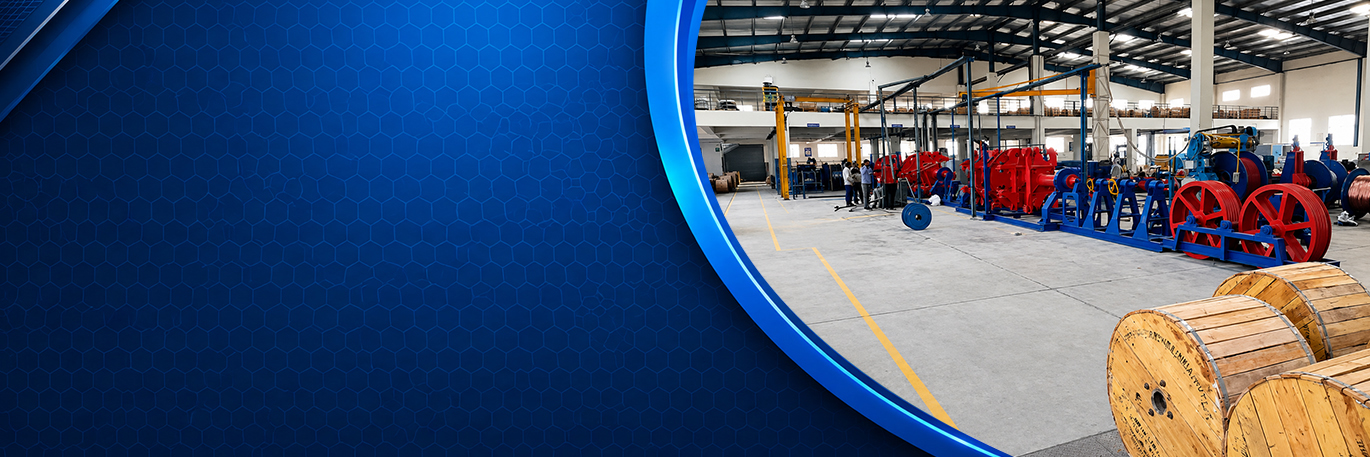
Akash Industries & Sons manufactures cable processing equipment for manufacturers that need better control over these operations. Our machinery is designed to support steady core laying, smooth mechanical movement and reliable performance during long production runs. Depending on the cable design and production volume, we can configure the equipment with a single cage or a double cage.
What Is a Conductor Twisting Machine?
A conductor twisting machine is a machine that brings several wires or conductor elements together and twists them into a required formation. The machine is usually chosen based on conductor size, material, cable diameter, number of elements and production speed.
What Does the Machine Do?
The machine handles several tasks at the same time. Individual bobbins feed the conductors, the rotating cage brings them together, and the take-up unit pulls the finished cable forward at a controlled speed.
Depending on the machine setup, it can provide:
- Steady feeding of individual conductors
- Continuous cage rotation
- Adjustment of lay length
- Better control over cable tension
- Coordinated movement between machine components
- Controlled collection of the finished cable
- Variable-speed operation for different production requirements
Technical Specification of Our Conductor Twisting Machine
| Specification |
Details |
| Bobbins per Carriage |
12 / 24 / 36 / 48 / 54 / 72 / 96 |
| Bobbin Diameter as per DIN |
400 / 450 / 500 / 630 mm |
| GI Strip |
4.0 × 0.8 mm |
| GI Round Wire |
0.7–4 mm |
| Cable Diameter |
20–100 mm |
| Lay Length |
35–1000 mm |
| Centre Wire Pay-Off Drum |
1250–2500 mm |
| Carriage RPM |
125 / 100 / 75 / 50 / 30 |
| Take-Up Drum |
1250–3000 mm |
| Drive |
AC Variable Frequency Drive |
Cable Types Supported by the Machine
The machine can be used for processing power and control cables, depending on the production setup. It handles both round-wire and flat-strip armouring, giving manufacturers more flexibility for different cable constructions.
It is a practical choice when the production process requires consistent armouring, smooth material movement and reliable performance during continuous cable manufacturing.
Available Machine Models
Akash Industries & Sons offers several armouring machine configurations. The right model depends on the material size, bobbin requirement, cable construction and production speed.
| Model |
Wire/Strip Size |
Maximum Rotor RPM |
Bobbin Size |
| AIS/ARM/24 |
1.5–4 mm |
160–140 |
400 / 450 / 500 mm |
| AIS/ARM/36 |
1.5–4 mm |
150–130 |
400 / 450 / 500 mm |
| AIS/ARM/48 or 24+24 |
1.5–4 mm |
120–110 |
400 / 450 / 500 mm |
| AIS/ARM/72 |
1.5–4 mm |
100–80 |
400 / 450 / 500 mm |
| AIS/ARM/96 |
1.5–4 mm |
80–60 |
400 / 450 / 500 mm |
There is no single configuration that works for every cable. Cable diameter, armouring material, wire or strip size, production capacity, bobbin count and required operating speed all need to be considered before selecting the machine.
Key Features of Conductor Twisting Machine
The machinery is built for regular industrial use and includes practical features that help keep the cable production process under control.
- Self-supporting cage rotor: Provides a rigid and stable structure while the cage is rotating.
- Pneumatic braking: Helps bring the machine to a controlled stop and manage material movement.
- Multi-speed gearbox: Gives operators the flexibility to select a suitable cage speed for different jobs.
- Heavy-duty capstan: Keeps the cable moving steadily through the production line.
- Fleet ring: Guides the cable around the capstan for smoother and more controlled movement.
- Adjustable lay: Lets you set the lay length according to the cable construction and production requirements.
Applications of Conductor Twisting Machine
- Power cable manufacturing
- Control cable manufacturing
- Round-wire armouring
- Flat-strip armouring
- Industrial cable processing
- Continuous cable production
Get the right machine configuration for your requirements. Based on these requirements, Akash Industries & Sons can help you determine a suitable machinery configuration for your application.
Frequently Asked Questions
A conductor twisting machine brings multiple wires or conductor elements together to form a specific cable construction. During the process, the machine controls the movement and lay so that the conductors follow the required arrangement.
The main purpose is to combine individual wires or conductor elements into a defined construction. Maintaining the correct twist and lay helps achieve the required cable shape and construction.
Start with the cable you intend to manufacture. Wire diameter, finished cable diameter, number of bobbins, lay length, rotor speed, take-up drum size and required production capacity all influence the machine configuration.
The published specification lists a cable diameter range of 20–100 mm.
The specified lay-length range is 35–1000 mm. The actual setting will depend on the cable construction and the production requirement.
Depending on the machine arrangement, configurations are available with 12, 24, 36, 48, 54, 72 and 96 bobbins per carriage.
The machinery uses an AC variable-frequency drive (VFD). This allows the operating speed to be adjusted to suit different production requirements.
Yes. The equipment is designed for round-wire and flat-strip armouring of power and control cables. Depending on the production setup, both single-cage and double-cage arrangements can be used.