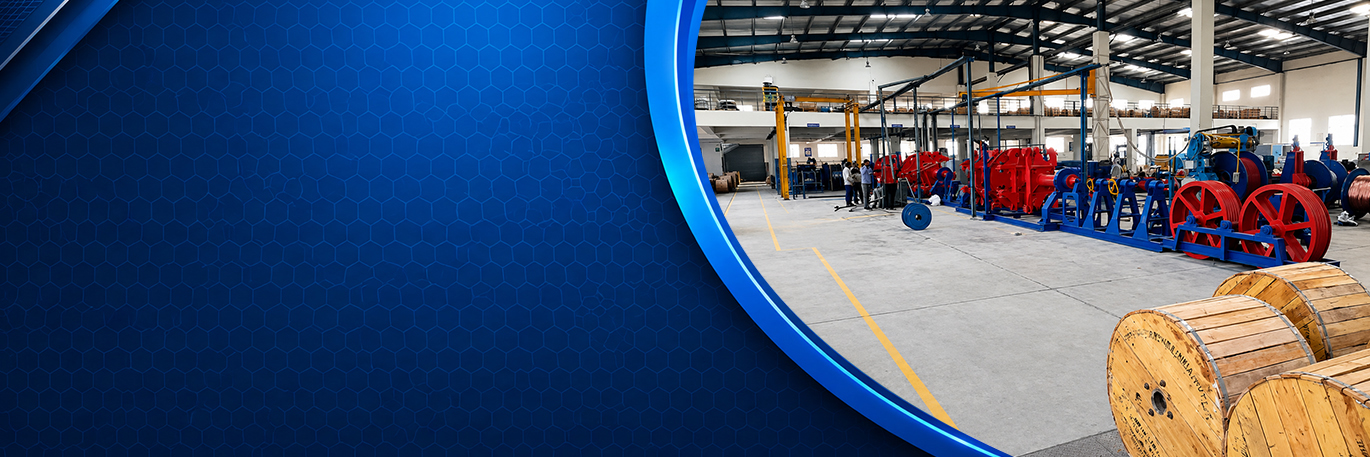
Akash Industries & Sons supplies cable and conductor processing machinery for industrial applications. As Aluminium Conductor Twisting Manufacturers, we provide machine configurations based on practical production requirements such as cable diameter, bobbin capacity, lay length, carriage speed and overall output.
Designed for Aluminium Wire Processing
Aluminium is widely used for electrical conductors because it offers good electrical conductivity while being lighter than copper. At the same time, aluminium behaves differently during processing because of its lower density and mechanical properties. This makes proper wire feeding, tension control and stranding important for consistent production.
The machine should be selected according to the aluminium wire diameter, number of wires, finished conductor size, required lay length, and production speed. These factors determine whether the machine can handle the conductor construction you need.
Factors for Aluminium Conductor Twisting
| Parameter |
Why It Matters |
| Wire Diameter |
Helps determine the suitable pay-off and stranding arrangement |
| Number of Wires |
Affects the overall conductor construction |
| Lay Length |
Determines how the individual wires are positioned around the conductor |
| Finished Diameter |
Helps establish the required machine capacity |
| Production Speed |
Determines the expected production output |
| Wire Tension |
Helps maintain steady and consistent wire feeding |
| Pay-Off Arrangement |
Provides a smooth supply of individual wires |
| Take-Up System |
Collects the finished conductor continuously during production |
Consistent Lay for Better Conductor Construction
Lay length is one of the key settings in conductor stranding. It refers to the axial distance covered by a strand while making one complete turn around the conductor.
Keeping the lay length consistent throughout production helps maintain a uniform conductor structure. It also makes the finished conductor easier to handle during later cable manufacturing processes. Because even small variations can affect the finished construction, the machine needs to provide suitable control over wire feeding and strand formation.
Applications for Our Aluminium Conductor
Aluminium conductor twisting machinery can be used for different stranded conductor constructions, depending on the machine's working range and configuration.
Typical applications include:
- Stranded aluminium conductors
- Aluminium electrical conductors
- Overhead conductor manufacturing
- Power transmission and distribution conductors
- Cable manufacturing
- Electrical wire processing
The exact conductor type that can be produced depends on the machine configuration, conductor dimensions and applicable manufacturing standard.
Get the Right Twisting Machine
Planning to manufacture aluminium conductors? Share your wire diameter, number of wires, finished conductor size, required lay length and expected production capacity with Akash Industries & Sons.
Having these details ready makes the machine selection process easier and helps avoid choosing equipment that does not match your production requirements.
FAQs (Frequently Asked Questions)
An aluminium conductor twisting machine combines individual aluminium wires into a stranded conductor with a specified lay length and conductor construction.
Twisting brings multiple aluminium wires together in a controlled arrangement. Consistent wire tension and lay help maintain the required shape and structure of the finished conductor.
Important factors include aluminium wire diameter, number of wires, finished conductor diameter, lay length, production speed, pay-off arrangement and take-up capacity.
Lay length is the axial distance travelled by an individual strand while making one complete revolution around the conductor. It is an important setting because it affects the construction of the finished conductor.
It depends on the machine's design and operating range. Factors such as wire diameter, strand count, finished conductor diameter and available machine adjustments determine the range of conductors that can be produced.
The types of conductors that can be produced depend on the machine configuration and the required manufacturing standard. Different stranded constructions may be possible by changing the wire count, conductor dimensions and machine settings within the specified operating range.
Controlled tension helps individual wires move consistently towards the stranding point. Uneven tension can affect the lay and the overall geometry of the finished conductor.
Start with the aluminium wire diameter, number of wires, required conductor diameter, lay length and target production speed. These specifications provide the basic information needed to determine a suitable machine configuration.
Contact Akash Industries & Sons with your conductor specifications and production requirements. The technical team can discuss your application and help determine a suitable machinery configuration.